

The Accelerate ED Designathon: Co-Designing Seamless Transitions for Dual Enrollment Students to Day One in College
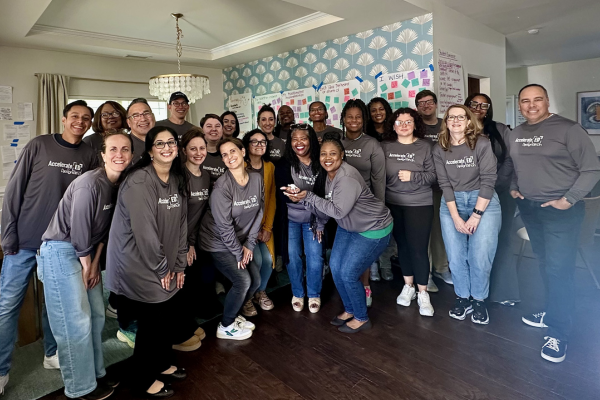
Over the past few months, ESG has tested out a new approach to user-centered design: putting the process of creating tools and resources in the hands of those who will use them. From the start of the Accelerate ED initiative in 2022, we have worked to build a community where practitioners from across the country see themselves as co-creators of solutions.
Last summer we canvassed the Accelerate ED community to identify common problems of practice that multiple sites were facing. After the community winnowed down the ideas, a powerful guiding question emerged that multiple sites wanted to tackle together:
How might we strengthen the connection between dual enrollment and full postsecondary matriculation at the same institutions, creating seamless transitions that significantly increase the likelihood of students persisting in their chosen pathways?
To address the shared problem of practice, we created a Designathon: a time-limited, intensive, vibrant process of quickly moving from identifying barriers to co-creating practical, high-impact tools for the participants to adapt in their own communities, and also serve as public resources for the Accelerate ED community and beyond.
This collaborative design process to strengthen the bridge from dual enrollment to full postsecondary matriculation was intentionally designed to marshall the diverse skills and experiences of 25 practitioners and partners from 7 states, representing community colleges, K–12 districts, intermediaries, and research organizations.
Through four virtual meetings; a three-day in-person design sprint in Charlotte, NC; and ongoing asynchronous collaboration, teams explored root causes, generated solutions, and rapidly prototyped practical tools. The process centered on real practitioner insights, iterative feedback, and a commitment to creating resources that could be immediately useful across diverse contexts. The outcome was more than a collection of ideas. It was a shared vision for how systems can better support students navigating pathways.
The result is three public goods that can be used independently or together to support practitioners and system leaders in moving students from participation in dual enrollment to college matriculation:
- Belonging by Design: A resource that surfaces practical strategies and starting points for programs to cultivate a strong connection to the partner college for dual enrollment students.
- A Data Sharing Framework that offers guidance for colleges and districts on approaches to begin and strengthen data sharing across sectors to inform decisions and actions.
- Engagement Practices: Practical strategies to gauge students’ connection to the college where they are taking dual enrollment courses, and suggestions for practical approaches to strengthening student engagement.
These tools were designed with a wide audience in mind, to be adapted by districts and colleges across the Accelerate ED community and beyond. These resources will help partnerships put insights into action to transform the dual enrollment experience, strengthen collaboration, and create seamless transitions that boost student success.

