

Extending the Runway: A Policy Blueprint for States
You get a policy! And you get a policy! Everyone gets a policy!
Please tell me you got this reference to Oprah’s iconic “Everyone gets a car!” moment. I’m sorry to tell you that I have zero cars for you, BUT I do have something way more impactful.
As part of our inaugural cohort for the Middle School Career Exploration Learning & Impact Network, ESG and Britebound recently released a set of model policies designed to help states beef up their framework of codified expectations for what middle school career exploration should look like, how it should be delivered, and by whom. I’m pleased to announce that these policies are finally out in the world for states’ adopting pleasure.
Let me back up a minute and talk about how these came together. When we were conducting research for Extending the Runway, we dug up all manner of policies that showed the varied ways states approached middle school career exploration. Over the course of that research, some themes emerged: lots of states were requiring some sort of planning process (such as an ICAP, High School and Beyond plan, etc.); some states required middle school students to take career exploration coursework; some even laid out definitions for what the heck middle school career exploration even meant. All of this is important. On the other hand, there are other important things that consistently weren’t explicitly addressed anywhere – namely monitoring these practices and thorough data collection and accountability mechanisms.
We wrote the report, reflected a bit, and thought to ourselves – well wait, isn’t it kind of all of those things? Shouldn’t we tackle this very important and meaningful (dare I say, life-changing!) endeavor for our young people in a multi-faceted way that shows we want them to have quality experiences?
One of our biggest takeaways from our research, including direct input from students, was the activities named in these policies – the ICAPs, the optional elective, etc. – all have the potential to be a check-the-box exercise that districts can do once and keep it moving. That’s not to say that the legislators or board members who passed these policies intended for this to be this way, nor that districts, schools, or educators don’t genuinely want to help middle school students “find their why” and how to get there. It’s just the nature of policy sometimes.
How do we prevent this? I think it’s helpful to just name that it’s a framework. There are plenty of ways we can facilitate career exploration through a policy vehicle if we are explicit and detailed in naming all the things that we expect of the state, districts, schools, and educators. Naming those things helps give folks a picture for what actual implementation should look like – and that, my friends, is where the magic actually happens.
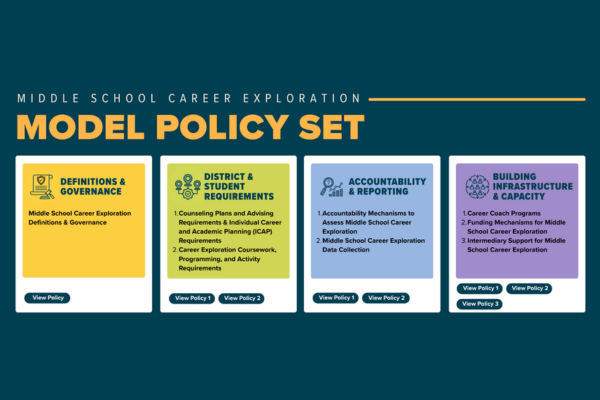
To do this, we created model policies for middle school career exploration (summarized here) that a state can easily pull down, customize to their context, and adopt to add to what they may already have going on to drive quality career exploration practices at our middle schools. Here are the policy buckets within which we’ve worked:
- Definitions & Governance: We were struck by the power of codifying “middle school career exploration” in statute or rule. In my former policy life, I’ve talked to districts and schools who look to statutes and rules as the source of truth for how to do a thing and what exactly is expected of them. Yet, when we looked for this across states, so many included definitions in say, a work-based learning guidebook, or on their career advising webpage.
Are those important and helpful? YES. Do they reach all the districts and schools in the same way that something passed by a governing body can? Probably not. This policy provides all the definitions your state needs to let folks know what middle school career exploration is, the expected outcomes, and specific delivery expectations so that all middle schoolers can benefit.
- District & Student Requirements: As I stated, there are a few ways that students can receive quality career exploration experiences. Can they explore careers through some sort of ICAP process? CERTAINLY. Would a course be helpful in helping them connect their strengths and passions with prospective careers? OF COURSE. Should there be an explicit expectation that every adult in the building can serve as a career exploration resource? ONE HUNDRED PERCENT.
The thing is, some states have one of the three things outlined in their expectations. It’s a good start. But to promote an environment where students have ongoing experiences and are consistently challenged to think about their futures, we offer all of these district and student expectations for states to think about adopting so that they’re tackling this in multiple ways.
- Accountability & Reporting: This is the big one! There are only a few examples that we identified to serve as a jumping off point for states to incorporate middle school career exploration in their accountability systems. Think ESSA Plans, state accountability systems, or Perkins Plans – those big ol’ documents that go through a million layers of review. The ones that outline the metrics states want to look for to assess whether districts and schools are helping kids achieve certain outcomes.
We know the go-to outcomes, though, don’t we? Test scores, graduation rates, etc. YES those are important; but I would argue that monitoring the efforts to make academic content more relevant through career connected learning and guiding students through a process that helps them figure out what to do with their life are equally important! And these model policies can help states figure out how to go about that.
- Building Infrastructure & Capacity: Finally, we have capacity building. Policies have the potential to remain just words on paper (or even worse, the dreaded unfunded mandate…) if states do not contemplate how to build the infrastructure and provide capacity to make the intention behind those words show up for kids. I’m talking about career coaches, intermediary networks, and dedicated funding streams. These are the kinds of policies that you can find here to help your state facilitate the practices that we KNOW will help kids find a fulfilling career.
I’ll end with a fun fact about me: When I was trying to figure out what to do for grad school, I had two options in mind: pursue school counseling, because I loved the idea of helping kids think about their unique personalities and what careers would align with their aptitudes and interests; or pursue education policy because I understood that was an avenue that – when done right – has the potential to make positive change at scale. While I ultimately went the policy route, this model policy set is like my two grad school dreams had a baby. I am thrilled at the prospect of these being used to help kids (like mine!) dream big for their own futures.
Could your state use these model policies? Let me know at tyoung@edstrategy.org

