

Toward Field-Building: Five Takeaways from Lumina’s FutureReady States Convening
In 2025, Lumina Foundation set an ambitious goal: by 2040, 75 percent of adults in the U.S. labor force will hold a college degree or other credential of value leading to economic prosperity. Subsequently, the organization launched FutureReady States. This new initiative empowers 12 participating states (Alabama, Colorado, Connecticut, Illinois, Louisiana, Michigan, Mississippi, New Jersey, North Carolina, Tennessee, Texas, and Virginia) by supporting policy development and providing technical assistance to strengthen their workforce training programs.
The timing of FutureReady States could not be better. Higher education is undergoing a significant transformation, driven by evolving workforce demands and persistent calls for postsecondary institutions to deliver real value to learners and their families. Enrollment growth at community colleges is driven in part by short-term credentials. This momentum is only accelerated by the 119th Congress, which passed the One Big Beautiful Bill (OBBB) in July 2025 paving the way for Workforce Pell, a long-sought bipartisan priority at the federal level to extend Pell grants to learners pursuing quality short-term training programs.
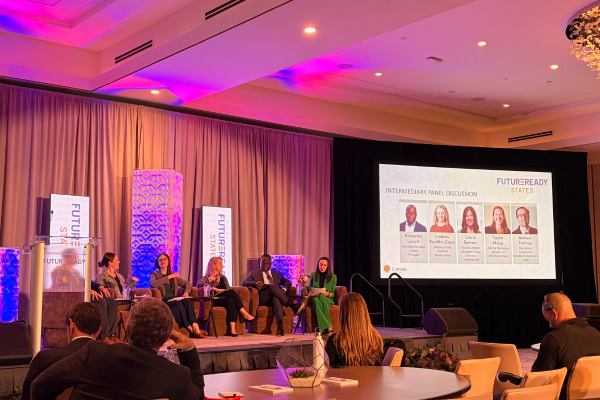
 Last week, I was thrilled to join Lumina’s first in-person convening of the 12 FutureReady States in Nashville, Tennessee. Education Strategy Group proudly serves as a supporting intermediary and technical assistance provider for Michigan, Tennessee, and Virginia. The energy was palpable, from genuine peer learning that took place in every breakout room to the expertise shared by states and national partners. This energy was only furthered by excellent branding of the initiative across the hotel. Yes, even the elevator doors were branded to convey the message: states are FutureReady. From this convening, which gathered some of the field’s brightest minds, it is clear to me that higher education, workforce, and industry leaders are ready to make current descriptors of the short-term credential landscape like “the wild west” or “black box” a thing of the past.
To achieve such transformation, there is also equal recognition that strategic state policy decisions and investments need to be made to bolster short-term credentials, and that each policy action must be coupled with bold leadership to truly align higher education and the workforce.
To celebrate this event and pave the way for the next 12 months of action, I want to offer my five key takeaways:
1. There is a critical need for clear definitions and taxonomies for short-term credentials. The short-term credential landscape is vast and changing rapidly. It is critical that state and institutional policy reflect the nuance of credential types (e.g. certificate, certification, occupational licenses, microcredentials, badges, apprenticeships, etc.). States need clear taxonomies and typologies to categorize short-term training in a way that is meaningful for future datasets and “credential of value” lists. In this area, I continued to be impressed by Michelle Van Noy, Mark D’Amico, and the team at the Rutgers Education and Employment Research Center for their Noncredit Data Taxonomy 2.0 and Implementation Guide for States, a foundational tool for building this critical infrastructure.
It is also vital to clearly define “value” and related thresholds: high-wage, high-demand, high-skill, high-growth, and stackability, among others. As states identify and reward the attainment of credentials of value, they must have clear, defensible mechanisms for proving value to the learner and regional economies. States should consider codifying these meaningful measures in statute and holding all institutions delivering short-term training accountable.
2. Credentials of value must move beyond employer validation to true partnership and commitment. Leadership from AdvanceCTE, Kate Kreamer and Dr. Emily Passias, presented an insightful, comprehensive analysis of the 44 states that publicly release credential of value lists, including how those lists are curated at the state level. Two lingering questions that struck me during several conversations on credential of value lists were: How might we move beyond mere employer validation of these lists to true employer commitment? How can states position employers as co-designers of credentials of value?
Meaning, employers and industry associations are actively at the table with higher education to co-design educational and training solutions, and in return, give preference in hiring decisions to graduates completing credentials of value to fill in-demand occupations for example. Does anyone have a system-level solution for this today? I don’t think so, but these are critical questions that deserve deeper consideration.
3. Seamless stackability is a core credential quality criterion. As part of this initiative, ESG conducted comprehensive desk research to understand the current possible stackable pathways in Michigan and Tennessee, specifically industry-recognized certifications and occupational licenses that are articulated for credit. Our findings revealed over 80 certifications in Tennessee and 86 certification bodies or licensing agencies in Michigan with established credit-equivalency awards.
Having a running list of these stackable industry-recognized credentials is important, as stackability is a quality criterion for Workforce Pell. But what is more important for learners is the ability to actually progress along these pathways. State leaders need to intimately understand the conditions that enable, hinder, or actually prohibit seamless, automatic stackability for the individual. I am excited that leadership in both Tennessee and Michigan are committed to defining and designing for stackability in meaningful ways through FutureReady States. This work builds upon ESG’s body of work focused on noncredit and credit alignment, which extends far beyond articulation agreements but recommends providing learners in short-term programs a suite of wraparound supports to enable progress along a pathway.
4. States must invest in capacity for noncredit and non-degree data systems. We simply didn’t have enough time to discuss all the data challenges, resource constraints, and needs required to address gaps in noncredit and non-degree data. Although, it is clear that state leaders are eager to enhance earning and employment outcomes tracking for short-term credentials.
Building this capacity is no easy feat, but there is progress being made. ESG’s Noncredit Mobility Academy, Rutgers EERC State Noncredit Data Project, and CredLens, an affiliate of Strada Education Foundation building a non-degree credential data trust are all excellent examples. However, more investment is urgently needed for states and institutions to meaningfully transform their data capabilities. It is my hope that more states will soon make strides similar to Iowa, which reports public outcomes data for short-term training, Virginia which communicates the state-level impact of non-degree credentials, and Louisiana, which successfully integrated noncredit and credit into one student information system, to prepare for Workforce Pell.
5. The field can’t wait to begin preparing for Workforce Pell. Dr. Casey Sacks, former Deputy Assistant Secretary at the U.S. Department of Education and current president of BridgeValley Community and Technical College, noted in her remarks that states and community colleges can begin preparing for Workforce Pell by identifying eligible programs, strategizing on implementation, and convening cross-state roundtables while patiently awaiting final rules. Steve Jurch, Associate Vice President at the Association of Community College Trustees, encouraged community college leaders to leverage the urgency of Workforce Pell as a catalyst for advancing institutional reform for noncredit education.
While there are current unknowns regarding Workforce Pell that need to be addressed through negotiated rulemaking, other elements within the OBBB are defined and community college presidents are ready to support their states in taking the lead. And I truly believe that if value is at the center, Workforce Pell could be transformative.
If you attended this marquee event, I am sure you are walking away with your own insights and ideas, and maybe an engraved whiskey glass and bandana, too! Whatever your key takeaways from FutureReady States were, I want to hear them and how you are leveraging any new discoveries back home.
Please reach out to keep the conversation going (kcumbass@edstrategy.org) and I am happy to connect you to our partners in Michigan, Tennessee, and Virginia. As my colleague Melanie Booth often reminds me, “we are all field-building,” and this convening made me grateful for who I get to do the building with.
I want to give a sincere note of gratitude to Kermit Kaleba, Georgia Reagan, Monica Robinson, Stephanie Murphy, and the full Lumina and HCM Strategist teams for a productive event. I look forward to the next one and continued learning alongside FutureReady States.

